The project
FragMENTS
A Non-Smooth Discrete Element Framework for Seismic Fragility Assessment of Historic Masonry Buildings


Croatian Centre for Earthquake Engineering (CCEE / HCPI)
Faculty of Civil Engineering
University of Zagreb
Croatian Science Foundation
Installation Research Project
36months of research
1 October 2026 –
30 September 2029
About FragMENTS
Seismic fragility of historic masonry
The project is based at the Croatian Centre for Earthquake Engineering (CCEE / HCPI), a research and professional branch of the University of Zagreb, Faculty of Civil Engineering.
Historic masonry buildings are an integral part of Zagreb’s city centre. Assessing their seismic response requires understanding how cracks develop, how walls interact, and how local failure mechanisms affect the stability of the building as a whole.
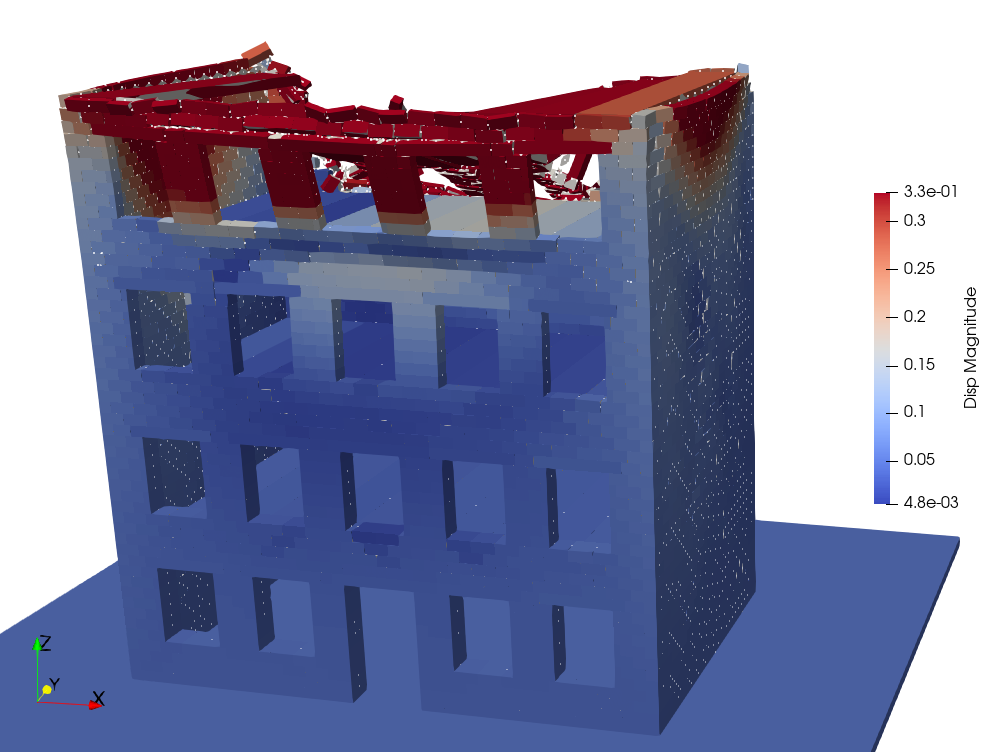
FragMENTS develops and validates a computational framework for assessing the seismic fragility of historic unreinforced solid-brick masonry buildings with flexible timber diaphragms, a typology characteristic of central Zagreb.
The approach is based on non-smooth contact dynamics (NSCD): masonry is represented as assemblies of rigid blocks whose contacts capture sliding, rocking, separation and progressive loss of connectivity. This allows the interaction between in-plane and out-of-plane wall behaviour to be represented explicitly, rather than treated as separate problems.
Full project title
A Non-Smooth Discrete Element Framework for Seismic Fragility Assessment of Historic Masonry Buildings
Where it started
Research rooted in Zagreb
The idea for FragMENTS grew out of the Study on Earthquake Consequence Mitigation — Phase XI, conducted in 2025 for the City of Zagreb under the leadership of Maja Baniček.
The study linked numerical simulations of local masonry collapse with estimates of debris distribution and the accessibility of evacuation routes in Zagreb’s Lower Town. The models and experience gained with LMGC90 raised new research questions.
FragMENTS addresses these questions through systematic discretisation, calibration and validation, and probabilistic fragility assessment, including buildings with pre-existing damage.