
News / Workshop
LMGC90 Workshop
Modelling masonry structures
When
2–4 December 2026
Wednesday: guest lecture at 10:00–12:00
LMGC90 sessions 13:30–17:00
Thursday & Friday: 09:00–17:00–12:00
Where
Zagreb, Croatia
University of Zagreb
Faculty of Civil Engineering
Three days of theory and guided practice in LMGC90, with a focus on contact mechanics and the modelling of masonry structures.
The workshop moves from the basic calculation workflow and 2D rigid-body examples to contact mechanics, 3D models and selected masonry applications. Participants will work with existing tutorials and scripts, supported by the organising team.
Lecturer
Frédéric Dubois · CNRS / LMGC, Montpellier
Practical support
Maja Baniček & Mahmoud Shaqfa
Contact: fragments@grad.unizg.hr
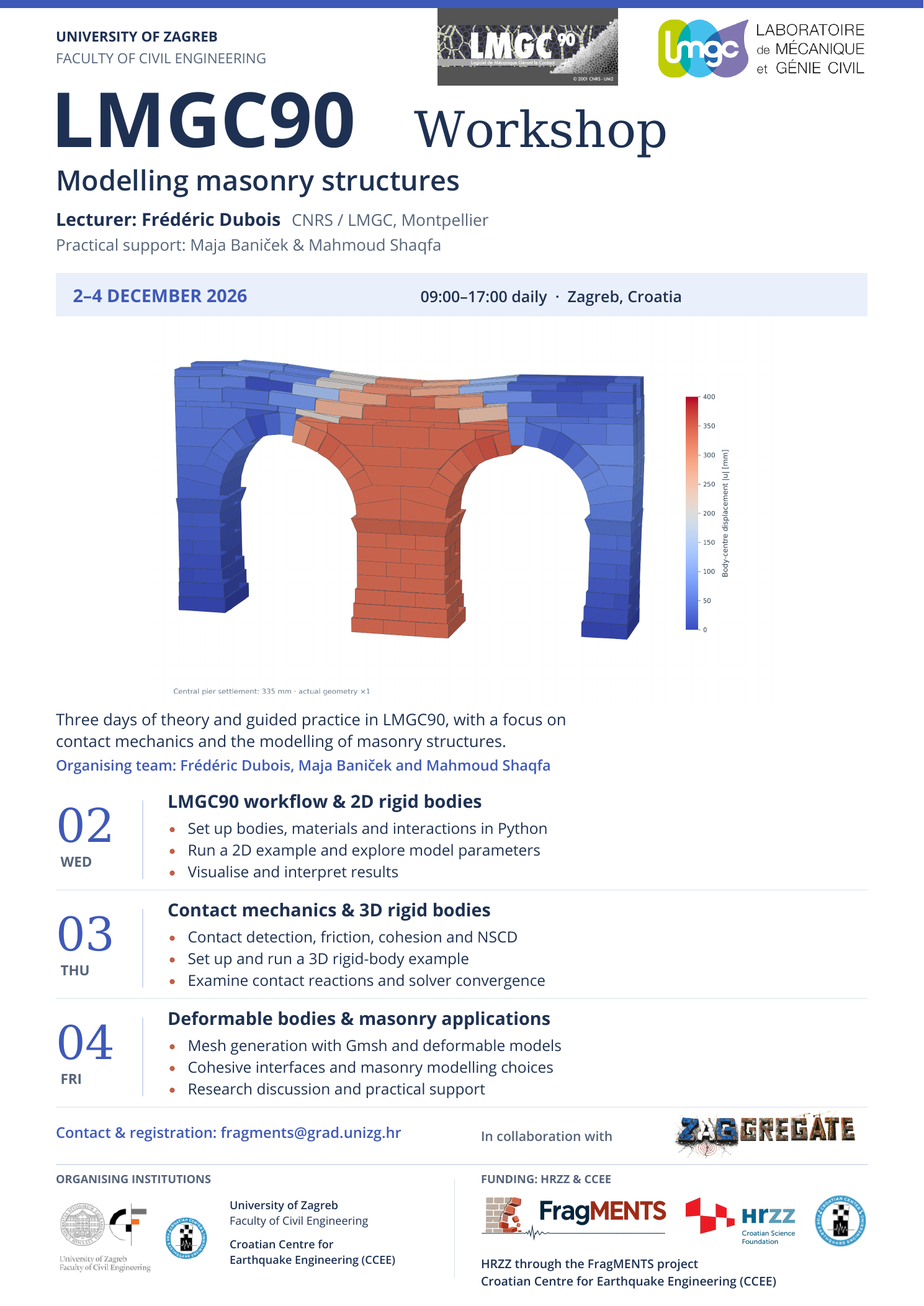
Schedule update: the programme includes the Notre-Dame guest lecture on Wednesday at 10:00–12:00 and supersedes the programme on the original flyer. Friday ends at 17:00.
Who it is for
Researchers, doctoral students and engineers.
Basic mechanics, introductory Python and Unix terminal skills are recommended. Previous knowledge of Non-Smooth Contact Dynamics (NSCD) or Cohesive Zone Models (CZM) is not required.
Participants should arrive with a working course installation. Software requirements and preparation details will be provided before the workshop.
Three days of training
Preliminary programme
Revised preliminary programme: Wednesday morning includes the Notre-Dame guest lecture. The workshop runs until 17:00 on Friday, with a final afternoon of guided masonry modelling. Minor adjustments may be made by the lecturer.
Notre-Dame guest lecture: details and venue ↗
Breaks: Thursday and Friday 10:45–11:00; daily 15:00–15:15. Lunch: daily 12:30–13:30. Wednesday morning is reserved for the guest lecture and the gathering that follows.
02
Wednesday, 2 December 2026
Guest lecture, LMGC90 workflow & 2D models
10:00–12:00
Guest lecture: restoration of Notre-Dame Cathedral
Frédéric Dubois, Great Council Hall. Followed by a discussion and an informal gathering with refreshments.
13:30–15:00
Calculation workflow and Python preprocessing
Preprocessing, computation and post-processing; bodies, materials, contactors, interaction laws and command scripts in an existing example.
15:15–17:00
Guided 2D practical and parameter exploration
Set up and run a rigid-body example; vary geometry, friction or loading, and visualise and interpret the results.
03
Thursday, 3 December 2026
Contact mechanics & 3D rigid bodies
09:00–10:45
Contact mechanics and NSCD
Contact kinematics, separation, sticking, sliding and impacts; time integration and the coupled contact problem.
11:00–12:30
Detection, solution and interaction laws
Contact detection, the Nonlinear Gauss–Seidel solver, and frictional and cohesive interactions.
13:30–15:00
Guided 3D practical
Preprocess and run a rigid-body example; examine contact definitions, boundary conditions and contact reactions.
15:15–16:00
Results and numerical settings
Inspect motion, reactions and solver convergence; distinguish physical instability from numerical difficulties.
16:00–17:00
3D modelling exercises and validation checks
Extend the worked example, verify contact definitions and boundary conditions, and document the calculation settings.
04
Friday, 4 December 2026
Deformable bodies & masonry applications
09:00–09:45
Introduction to deformable models
Distinguish material behaviour within a body from interaction behaviour at its boundary.
09:45–10:45
Gmsh and mesh preparation
Supplied geometry, physical groups, mesh dimensions, element types, mesh size and export.
11:00–12:30
Guided mesh-based practical
Import a mesh, assign the mechanical model, supports and loading, and inspect displacement and stress outputs.
13:30–15:00
Masonry applications
Selected examples of cohesive interactions, joint parameters, gravity equilibrium, loading and experimental comparisons.
15:15–17:00
Guided masonry modelling practical
Apply the course workflow to a selected masonry example, check interface parameters and numerical settings, and interpret and document the results.
Organisation & support
Hosted in Zagreb.
Organising team: Frédéric Dubois, Maja Baniček and Mahmoud Shaqfa.
Organising institutions: University of Zagreb, Faculty of Civil Engineering, and the Croatian Centre for Earthquake Engineering (CCEE).
In collaboration with ZAGGREGATE.
Funding: Croatian Science Foundation (HRZZ) through the FragMENTS project, and the Croatian Centre for Earthquake Engineering (CCEE).
For registration and practical information, contact fragments@grad.unizg.hr.